Supply, demand, and a spectacular backfire
I have to admit that one of my greatest pleasures is being right about the consequences of other people's actions. In this case, I did not expect to be proven right quite so soon.
As I had written before, the gates of the burgh are closed. It has become considerably harder to enter, remain in, and even leave this place, considering the recent case of a young man who dared to leave Portugal for an exchange program in Ireland after earning the opportunity through his academic performance, only to be deported to Brazil when he returned "home".
Back when these changes were first proposed, I immediately understood the government's intention. Beyond catering to the fears of the natives, who clearly cannot envision a less white country, reducing the flow of new arrivals would have an almost immediate effect on the labour market, pushing wages upward in the sectors most affected by the shrinking supply of labour.
For several years now, the country has been experiencing a fairly favourable employment situation. The unemployment rate remains very low by Iberian standards, while the employment rate continues to rise year after year. The "NEETs", young people who neither work nor study, are always a source of concern, but they seem perfectly comfortable living off their parents and, in many cases, government benefits while waiting for the "spark" that will finally make them get off their respective asses and emigrate.
Portugal, however, is a far more complex country than people imagine. It is a high-income country by global standards, integrated into the European Union from head to toe, and endowed with certain advantages that are often overlooked, such as its vast maritime territory thanks to the overseas territories of Madeira and the Azores. Yet its underlying economy remains highly extractive and extremely dependent on what is considered "unskilled" labor.
The concept of "unskilled" labor, however, is highly misleading. First of all, working in fields of this sort requires a willingness that the natives simply do not have. I immediately think of the graph below, taken from an opinion poll conducted by one of the great beacons of libertarianism, the Cato Institute, in which 80% of respondents, nearly 90% among Republicans, said the United States would be better off if more Americans worked in manufacturing. Yet only around 25% said they themselves would be better off if they worked in manufacturing.
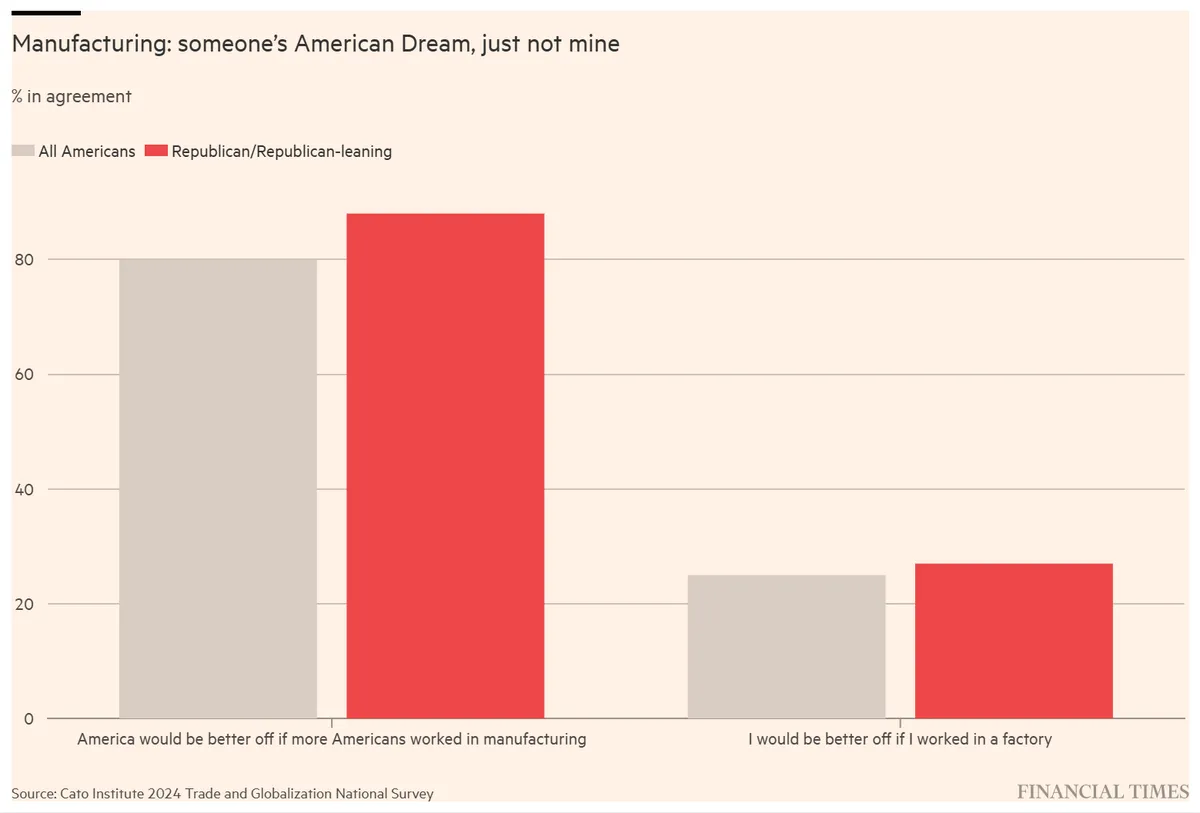
I have little doubt that the sentiment across the rest of the "west" is much the same, and the admittedly anecdotal evidence I see points precisely in that direction. Manufacturing jobs are highly valued by economists, politicians, lawyers, and the like, but nobody wants to walk into a factory at eight in the evening and perhaps not leave until eight the next morning.
The problem for the western native is that the people willing to fill these jobs, whether in manufacturing, agriculture, or any other field involving physical demands greater than sitting in front of a computer all day, are immigrants. So, in a scenario where labour becomes scarcer in these sectors, the wage gains also go to the immigrants whom these people would rather see disappear beyond their respective horizons.
It is such an obvious point that they chose to ignore it. And now we have Brazilian construction workers in Portugal being offered working conditions never seen before, even by the standards of native workers in the same field.
The fact is that Portugal and many other countries in the European Union have a chronic labour shortage in these supposedly "unskilled" occupations. Once again, the term is misleading, because tasks such as cutting meat, mixing mortar on a construction site, or even harvesting grapes are by no means easy. They are the sort of things that demonstrate how, when push comes to shove, a university degree in the labour market can be worth about as much as a piece of used, soggy toilet paper.
Personally, I am pleased not only because I was right in my assessment that the policy would fail to produce the government's expected effect of raising wages for its oh-so-poor voters, but also because it demonstrates that Europe has no other path to preserving itself than to accept that the continent is dying.
Without immigration, Europe will wither away under the weight of its own internal dynamics. We have already had a taste of this with the case of Ceuta and the collective condemnation directed at Spain over the "pull effect" supposedly created by the mass regularizations carried out by Pedro Sánchez's government, as well as decisions by the country's Supreme Court that were taken to suggest that those castaways from Africa fortunate enough to reach the beaches of the Spanish enclave would have a clear path toward becoming documented immigrants on that patch of land.
But I also cannot rule out the possibility that Europe actually desires this process of decline through its own dynamics and contradictions. It is hardly uncommon for people nearing the end of their lives to develop a death wish, and that may very well be Europe's case when the alternative is a continent that is not as white as it once was.
As history shows, the guns aimed at minorities eventually turn back toward the natives themselves. We are already seeing this in Portugal, with the current government attempting to introduce a labour reform containing liberalizing measures that are completely counterproductive given the present state of the domestic labour market. To follow, a report has just been released on the sustainability of Portugal's social security system that amounts to an extraordinarily lengthy defense of a privatized pension system, produced by figures who themselves work for and lead major private pension funds.
Welcome to the basal world, Europe.